

Why Rebranding is critical for your Business: What you need to know:
Have you ever considered a rebrand?
Several factors drive the decision to conduct a refresh of a brand’s look. As part of a rebrand, you might change your logo, business name or colour palette in an effort to modernise a brand or product.
But what would lead a business to rebrand and why is it an important consideration? This blog discusses what you need to know about rebranding and why it might be a good next step for your business.
What does rebranding entail?
A company considering a rebrand might review the match between its offering and its target market. Some questions arise:
“Do our offerings still appeal to our ideal customer?”
“Is our messaging engaging for a changing demographic?”
If these answers are no, it might be time to update the brand image. The next step is to update your existing values and logo. Depending on how well-known the old logo was and how large the company is, the extremity of the logo change is likely to vary. In most cases, the logo will be a more modern variation of the old one. Some brands may go for an entirely new concept, especially if it’s a rebrand for a start up which is now 2-3 years on the go.

Sometimes, more giant steps must be taken if a business is struggling, regardless of company size. In this case, the company is likely to rename itself and its product to create a rebrand which hardly resembles the old brand. Not only this, but its logo, colour palette and use of imagery will change accordingly.
When is it time to rebrand?
Rebranding is a natural step in the lifecycle of a business, and while it can be a difficult decision to make, rebranding allows you to realign with an ever-changing marketplace. Below are some of the most common signs that the time may be suitable for your business to rebrand.
Your Brand is out of date
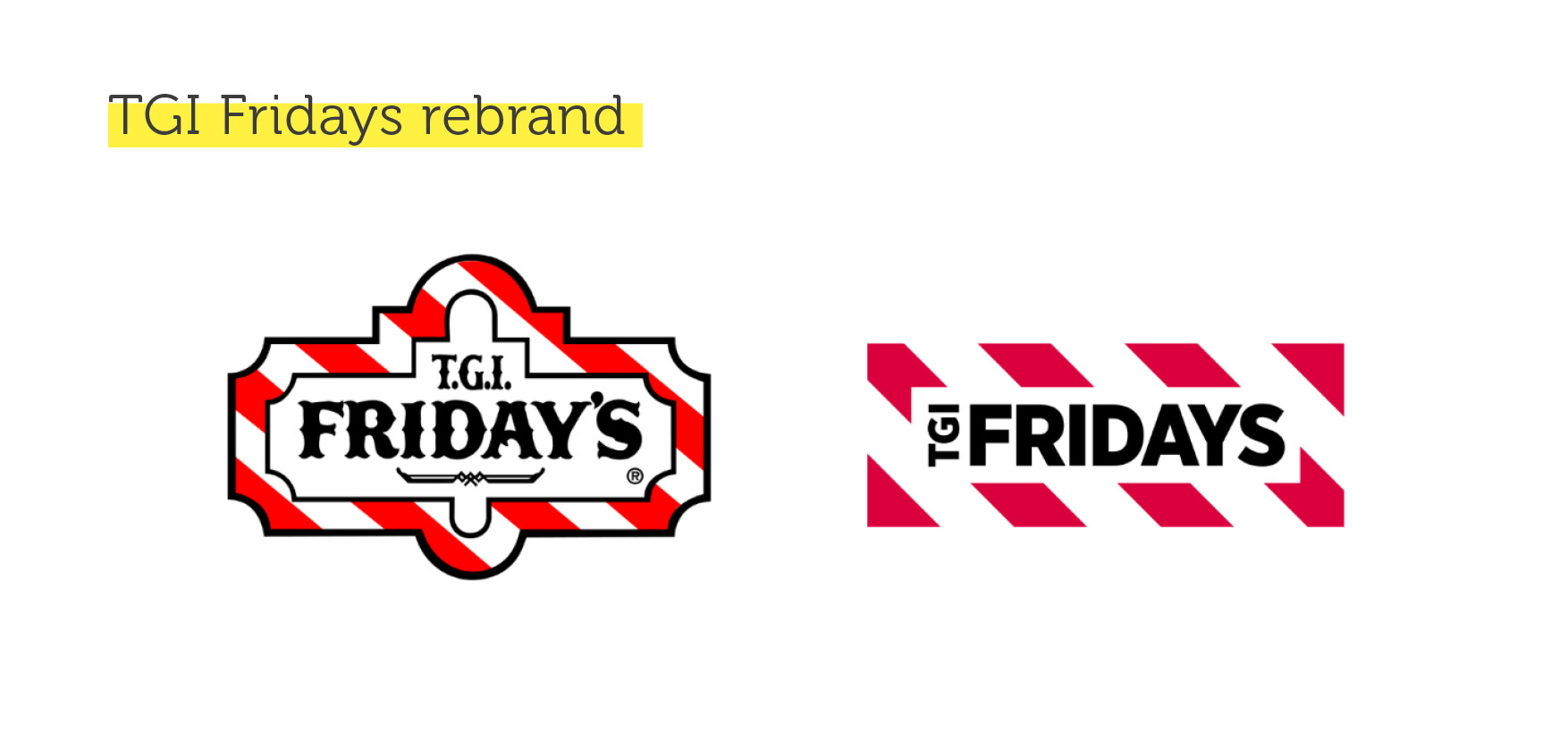
If your branding isn’t moving with the times, this is a key indicator to consider a refresh. Over the last few years, several brands simplified and modernised their logos. Toyota, TripAdvisor and TGI Fridays are just a handful of the brands that have simplified their logo, for example for an easier use on all digital channels.


Your offering has changed or been acquired
You might rebrand if you’ve changed your business in some way. A significant change could be a merger or acquisition. The first step will be to start with revisiting the basics, such as your purpose, values, vision and value proposition. Reflect on questions like:
- Why does my business exist?
- What direction are we heading?
- How will I get there?
- What values define our culture?
These principles act as a starting point, and remember that your target audience is a vital part of how you answer these questions.
Your target audience has changed or isn’t specific enough
Businesses often change or grow over time so without deliberate reviews of your brand, your target audience might disengage from you.
Your audience demographic may broaden or they may have different pain points from when you first started. A rebrand will allow you to define your audience clearly. If you discover you need to move towards a new group, that’s OK; as long as your new demographic knows the value that your business brings.
Poor brand image or perception is a challenge

If the overall perception of your company’s brand image is negative, it can lead to decreased sales, loss of market share and reputational damage. Scandals, negative reviews and legal issues are all good reasons to consider a rebrand. One benefit of rebranding is that it helps you distance your company from negative associations, giving you a chance for a fresh start.
What happens if a rebrand goes wrong?
Any rebrand comes with some risk. If you don’t do enough research or you don’t fully understand your goals, you run the risk of publicly showcasing a negative image. Gap’s rebrand in 2010 comes to mind where Gap wanted to take a big step and move away from the old logo which went a bit too far for their audience.

On October 6th 2010, clothing retailer Gap unveiled its new logo to its audience. A simple lettering of “Gap” with a small blue square partially covering the “p”. Within a day, the launch gathered over two thousand comments condemning the rebrand on Gap’s Facebook post. Moreover, a Twitter account devoted to shaming the logo gained almost 5,000 followers. A website emerged that allowed users create their own version of the logo. Before long, there were over 14,000 parody spins on the Gap’s new logo. The rebrand lasted six days before the logo reverted to its previous design and has since stayed the same.
What are the benefits of rebranding?

Rebranding can be a significant change for any business, but when done correctly, it can provide a number of benefits. Here are the top 5 benefits of rebranding your business:
1. Improved brand recognition
Rebranding can help to improve brand recognition by creating a new, more memorable identity that resonates with customers. This can lead to increased awareness, which can translate into increased sales and revenue.
2. More market share
A successful rebranding effort can help a small business to stand out from the competition and capture a larger share of the market. If you are looking to stand out in a crowded market where differentiation goes a long way, rebranding could get the results you want.
3. Enhanced company reputation
Rebranding can help to enhance a business’s reputation by addressing negative perceptions or associations that may have developed over time. A new brand identity can signal a commitment to change and help rebuild customer trust.
4. Better alignment with business goals
A rebranding effort can provide a chance to reassess its goals and values and ensure that its brand identity is aligned with those goals, for example, following an acquisition. This can help create a more focused, purpose-driven business better equipped to achieve long-term success vs short-term success.
5. Increased employee morale
Involving your employees in the rebranding process can be exciting and invigorating for them. A new brand identity can create a sense of pride and ownership, which can translate into improved productivity, loyalty, engagement, and job satisfaction.
A rebrand is more than just a logo. If you would like to discuss a brand refresh or rebrand, feel free to contact me for an informal chat at mail@anjapeter.com. I’d be happy to help!